Free eBook

Stop Programming Rules. Start Programming Strategy.

Why rule-based grow room control breaks down at scale — and what to do instead. A practical guide with a 90-day migration model proven across enterprise deployments.

  • Why revenue per square foot is the metric that matters most at scale
  • The hidden cost of rules: tribal knowledge, SOP drift, and yield variance
  • Rules vs. strategy — what’s actually different about dynamic control
  • What Blueprints are and how they replace static SOPs
  • A 90-day phase model for migrating without disrupting active rooms
  • The compounding operation: making every harvest your new baseline
13 pages Strategy eBook
V1 First edition
For Executives & VPs of Cultivation

Download the eBook

Fill out the form below and we’ll send it to your inbox.

What’s inside

13 pages of actionable strategy for scaling cultivation.

From diagnosing why your SOPs are breaking to a 90-day migration plan — everything you need to move from rules to strategy.
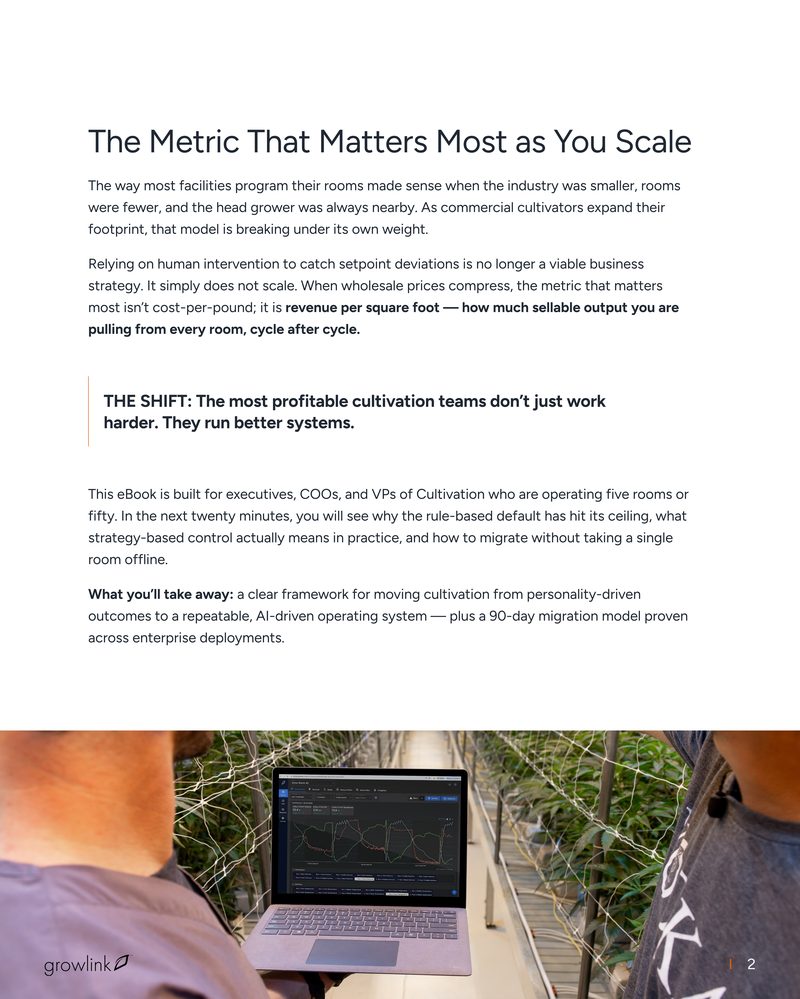
Commercial cultivation facility at scale
Introduction

The Metric That Matters Most as You Scale

Revenue per square foot — not cost-per-pound — is the number that separates profitable operators from the rest. Why the old model has hit its ceiling.
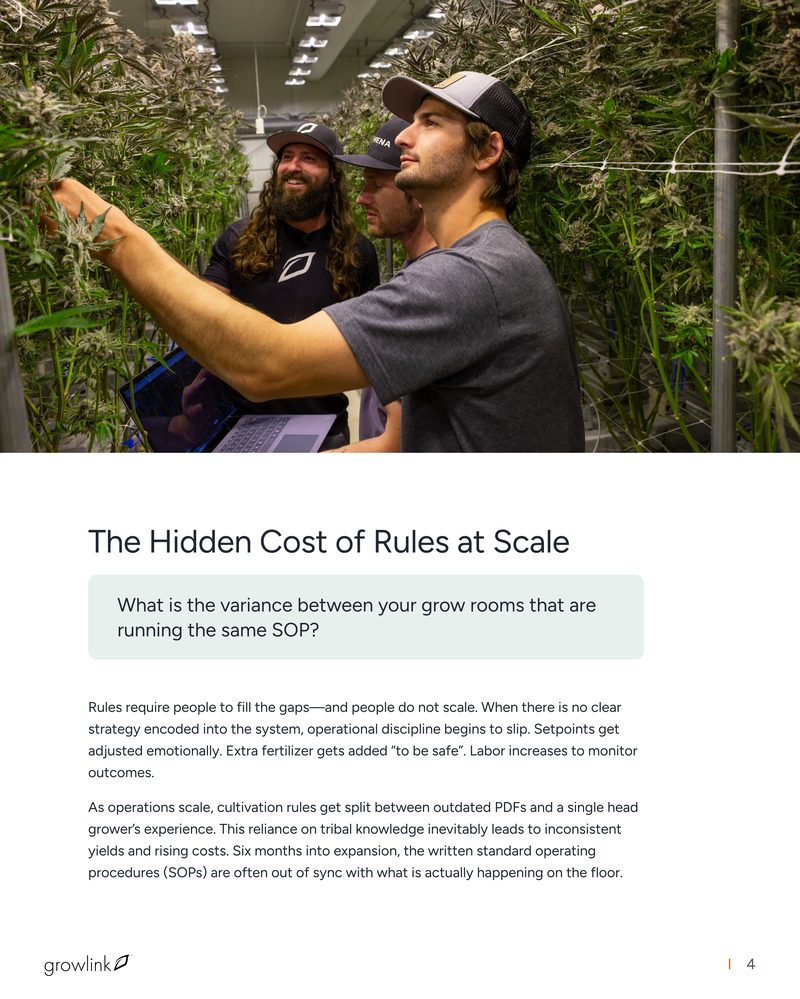
Grow room canopy under controlled environment
Chapters 1 & 2

The Rule-Based Default & Its Hidden Cost

Triggers, timers, and schedules were designed to keep plants alive — not to scale. Where rule-based SOPs predictably fail and the variance they create.
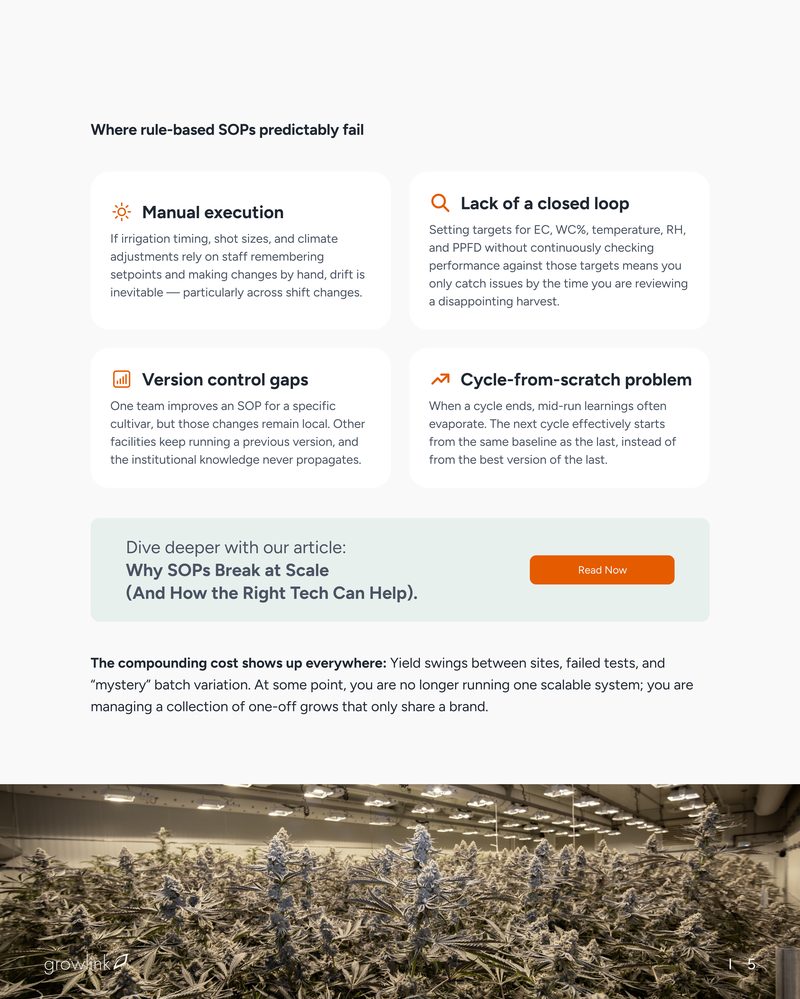
Cultivation team reviewing room performance data
Chapter 3

Rules vs. Strategy: What’s Actually Different

A rule reacts. A strategy anticipates. The gap between static rules and dynamic strategy is exactly where yield variance and labor inefficiency live.
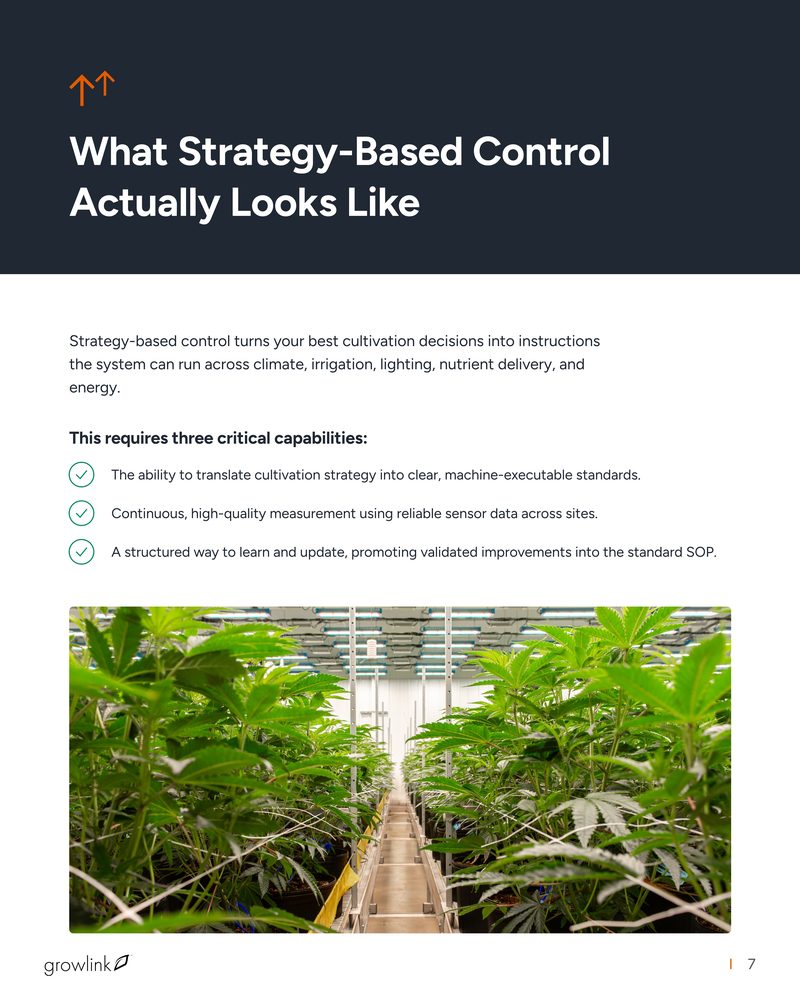
Strategy-based cultivation control dashboard
Chapter 4

What Strategy-Based Control Looks Like

Blueprints turn your best cultivation decisions into machine-executable standards — with pre-loaded baselines, mid-run versioning, and cycle-over-cycle learning.
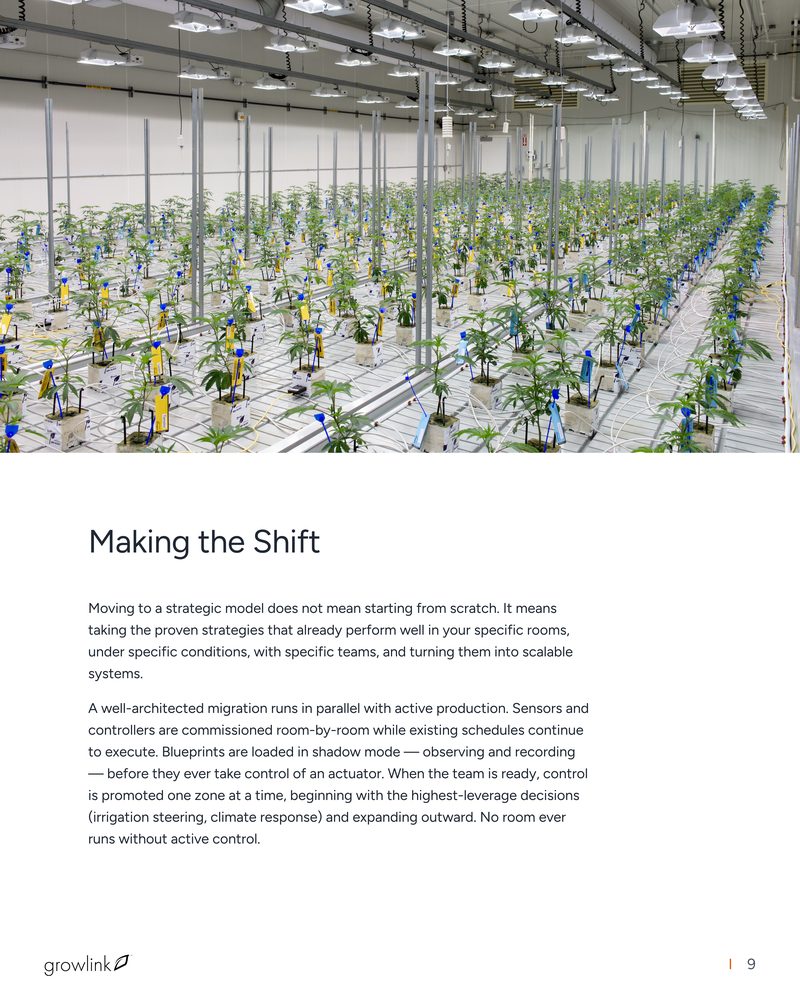
90-day migration roadmap for cultivation automation
Chapter 5

Making the Shift Without Disrupting Active Rooms

A 90-day phase model — from stabilization to compounding value — that runs in parallel with active production. No room ever goes offline.
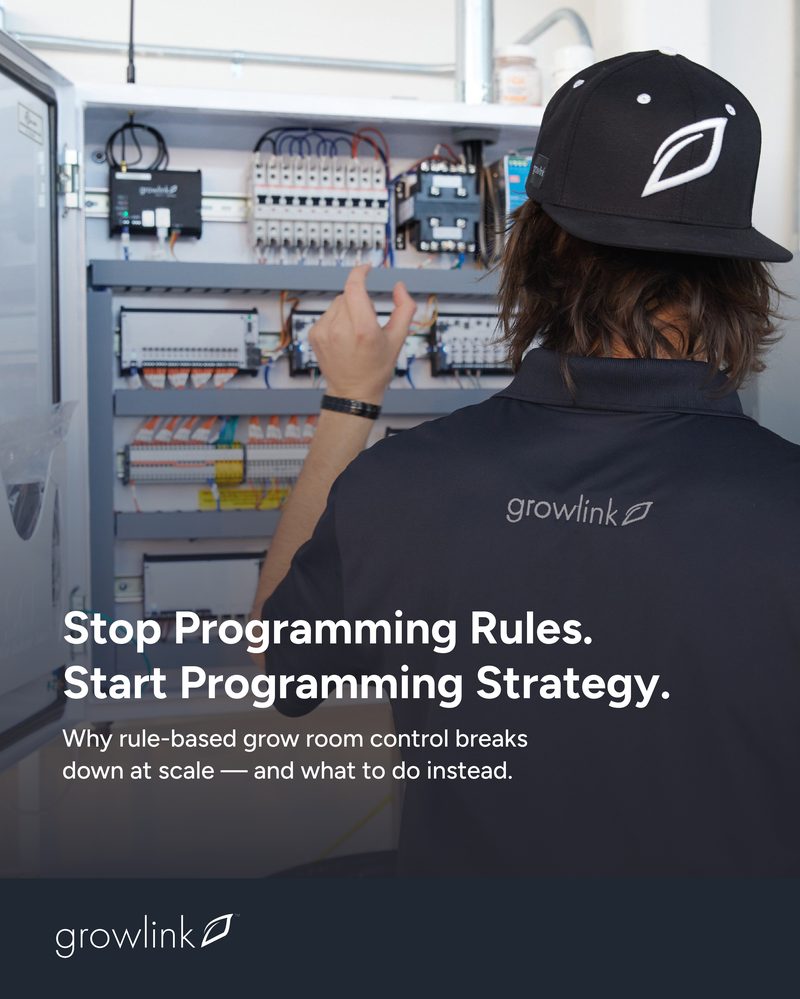
Growlink strategy-based cultivation control
Conclusion

The Compounding Operation

Predictable yield beats peak yield. How to make your best run the baseline for every run — and the P&L math to prove it.

Who it’s for

Built for operators scaling past five rooms.

CEOs & COOs

Build the financial case for moving from personality-driven outcomes to repeatable systems.

VPs of Cultivation

Learn how Blueprints replace static SOPs and compound your best grower’s decisions across every room.

VPs of Operations

Evaluate the 90-day migration model for multi-site deployment without taking a single room offline.

Board Members

Understand the yield, labor, and variance math that makes strategy-based control a P&L imperative.

Ready to see strategy-based control in your facility? Talk to the Growlink team →

Stop programming rules. Start programming your strategy.

Book a Demo