If you've been running AROYA for years, your operational intuition is calibrated to TEROS ONE readings. Your setpoints. Your feed strength decisions. Your dry-back targets. All tuned to the specific numbers AROYA puts on the dashboard.
That's a problem when you want to switch substrate sensor platforms, or expand coverage into more rooms with a different vendor. The hardware isn't the issue. The problem is that readings don't translate — pore EC 7 on one platform doesn't mean pore EC 7 on another. Your protocol stops working against readings it wasn't tuned for.
We built a new Terralink rockwool calibration to fix that specifically — and it’s trained the same way we train Nova and Co-Pilot.
A calibration trained on the fleet, not fit by hand
Traditional substrate sensor calibration is a hand-fit equation with four or five coefficients, tuned once in a lab. Growlink’s new rockwool calibration is a gradient-boosted machine learning model trained on more than 100,000 harvest cycles of real production data from thousands of commercial cannabis facilities on our platform.
That means two things. First, the calibration isn’t locked to the operating conditions of a single room — it’s learned from the full range of conditions our growers actually run, from aggressive crop steering to conservative sustainment, from early flower to late ripening. Second, the model can be retrained as the fleet grows. Every new room sharpens it. Every full crop cycle makes the next calibration better.
What the validation showed
We paired the trained model against the AROYA TEROS ONE in a working commercial flower room across a full flowering cycle:
A grower running AROYA-tuned setpoints against Terralink readings makes equivalent decisions through the full flowering cycle.
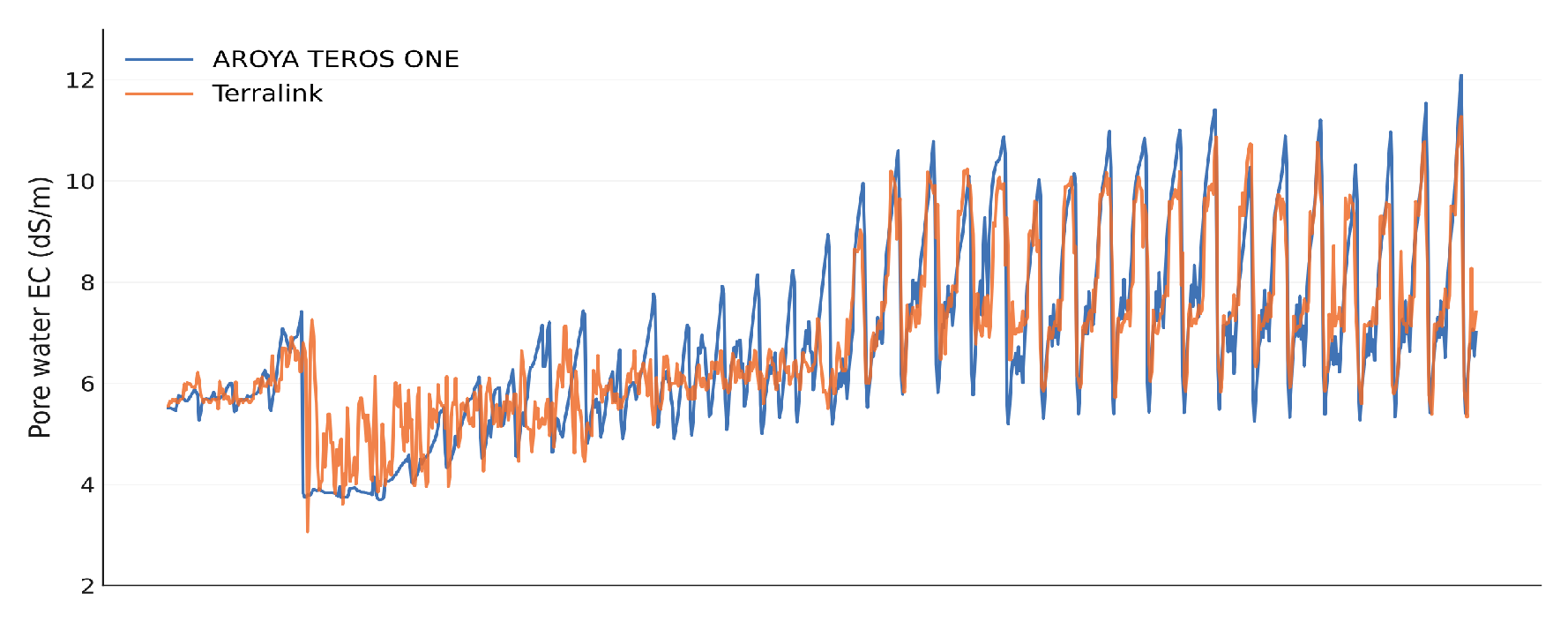
Terralink and AROYA TEROS ONE pore water EC readings, side by side in the same rockwool flower room, tracked through the full flowering cycle.
Still runs locally on your controller
The calibration is a free update to Growlink controllers. The ML model compiles directly into controller firmware — same deployment path as any Growlink update, no cloud dependency, no network latency for your irrigation decisions. Terralink sensors already installed in the field get the smarter calibration the same day it ships to new customers.
The full validation methodology
The complete technical brief — paired data methodology, sensor filtering, statistical treatment, scope of validation — is available here: Terralink AROYA-Compatible Validation Brief (PDF)